


Pool Cage Screen Replacement: The 2026 Homeowner’s Guide to Rescreening
- Michael Caruso

- Aug 16
- 12 min read
What if those small, frayed edges on your enclosure are actually early warning signs of a failing structural system rather than just a minor nuisance for bugs? It's a common realization for Florida homeowners who find themselves constantly clearing debris or swatting away pests that shouldn't be there. You want an outdoor space that remains a sanctuary, but the relentless UV exposure and coastal humidity eventually take their toll on even the best materials. Most screens in our region have a useful life of only 7 to 12 years, making a professional pool cage screen replacement a necessary step in protecting your investment.
We understand the hesitation that comes with conflicting advice on mesh types and the worry that your enclosure might not withstand the next major storm. This guide provides a clear framework for evaluating your current cage, choosing the right mesh for maximum airflow and protection, and deciding between targeted repairs or a full re-screen. We will examine the long-term ROI of premium materials like polyester-coated mesh and explain why structural components like Tapcons and tension cables are just as vital as the screen itself. By the end of this article, you'll have the technical knowledge needed to ensure your pool area remains clean, secure, and ready for years of use.
Table of Contents
When to Schedule a Pool Cage Screen Replacement
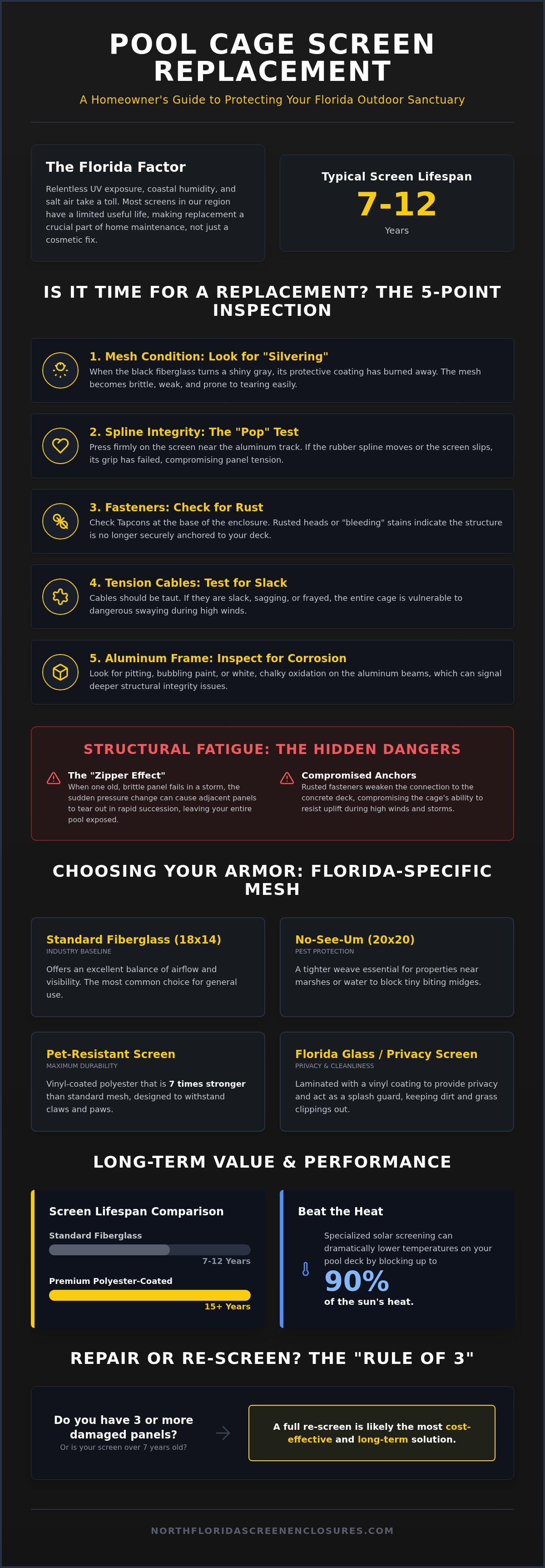
Homeowners often wait until a screen is hanging by a thread before considering a pool cage screen replacement. However, the unique coastal climate of Saint Augustine requires a more proactive approach. Salt air and intense UV rays degrade materials at a faster rate than in inland regions. A regular 5-point inspection is the best way to maintain safety and prevent unexpected failures during storm season.
To evaluate your enclosure, focus on these five critical components:
Mesh: Look for "silvering," where the black fiberglass turns a shiny gray. This indicates the protective coating has burned away, leaving the glass fibers brittle and prone to shattering.
Spline: Perform the "spline pop" test by pressing firmly on the screen near the aluminum track. If the rubber spline moves or the screen slips easily, the grip has failed.
Fasteners: Check the base of your enclosure. Rusted heads on Tapcons suggest the structure is no longer securely anchored to your deck.
Cables: Tension cables should be taut. If they are slack or frayed, the cage is vulnerable to wind sway.
Frame: Inspect the aluminum for pitting or white oxidation, which can signal deeper structural issues.
Visible Damage vs. Structural Fatigue
A single squirrel tear is easy to spot, but structural fatigue is more insidious. When screens reach 7 to 10 years of age, the entire system begins to weaken. Salt air from the Atlantic acts as an abrasive, accelerating this brittleness. If one panel fails during a storm, the sudden pressure change can create a "zipper effect." This happens when the tension loss causes adjacent panels to tear out in rapid succession, leaving your pool area completely exposed. Replacing the mesh before it reaches this point of total failure protects the aluminum frame from unnecessary stress.
The Hidden Danger of Rusted Fasteners
A pool cage screen replacement provides the ideal window to inspect the health of your structural fasteners. Standard steel screws often corrode when exposed to Florida's humidity, leading to "bleeding" stains on your deck. More importantly, weakened Tapcons compromise the entire cage's ability to resist uplift during high winds. If your fasteners are snapped or corroded, it's essential to seek expert pool enclosure repair St. Augustine services to restore the connection between the aluminum and the concrete. Replacing these anchors during a rescreen ensures the enclosure remains stable and safe for years to come.
Choosing the Right Mesh: Florida-Specific Options
Selecting the right material for your pool cage screen replacement is a decision that balances visual clarity with environmental protection. In Saint Augustine, our proximity to the coast means we face unique challenges, from corrosive salt spray to the relentless summer sun. The mesh you choose today determines how much maintenance you will perform over the next decade. Standard fiberglass mesh, typically an 18x14 weave, remains the industry baseline because it offers excellent airflow and a clear view of the landscape. However, homeowners near the Matanzas River or coastal marshes often require more specialized solutions.
No-See-Um (20x20) Mesh: This tighter weave is essential for North Florida marsh-front properties where tiny biting midges can pass through standard screens.
Pet-Resistant Screen: Made from vinyl-coated polyester, this is seven times stronger than standard mesh. It is designed to withstand claws and paws, though it does slightly reduce outward visibility.
Florida Glass (Privacy Screen): This is a standard mesh laminated with a vinyl coating. It is frequently installed on the bottom tier of panels to act as a splash guard and keep grass clippings or dirt out of the pool area.
UV Protection and Heat Reduction
Intense solar radiation is the primary cause of screen failure in Florida. While standard fiberglass mesh typically lasts 7 to 12 years, investing in polyester-coated mesh can extend that lifespan to 15 years or more. These high-performance materials are engineered to resist the "silvering" effect caused by UV degradation. Beyond durability, specialized solar screening can lower the temperature on your pool deck by blocking up to 90 percent of the sun's heat. This makes the outdoor space more comfortable during July and August without sacrificing the breeze. Choosing a mesh that fits your specific backyard environment ensures you get the most out of a complete re-screen.
TuffScreen and High-Durability Alternatives
For homeowners in wind-prone areas or those with high-traffic pool decks, heavy-duty alternatives provide necessary peace of mind. TuffScreen is a heavy-duty polyester-coated yarn designed to resist punctures. This material is nearly impossible to tear by hand, making it ideal for enclosures that face frequent storms or active children. Most premium polyester meshes come with 10-year manufacturer warranties, which is significantly longer than the limited coverage found on standard fiberglass. When you prioritize structural integrity and resilience, these high-durability options offer a much higher return on investment over the life of the enclosure.
Partial vs. Complete Re-screen: A Decision Framework
Choosing between individual repairs and a full pool cage screen replacement requires looking beyond the immediate damage. Homeowners often struggle with the decision to patch a single hole or overhaul the entire enclosure. To simplify this, we use the "Rule of 3" as a practical threshold. If more than three panels are damaged, or if those panels are on different planes of the cage, the structural fatigue of the remaining mesh is likely high enough to warrant a total replacement. Replacing panels one by one is a reactive approach that often leads to higher cumulative costs over time.
Labor logistics play a major role in this calculation. A professional crew must set up safety equipment and prepare the site regardless of whether they are replacing one panel or twenty. Consequently, the labor cost per square foot for a partial repair is significantly higher than for a complete project. There is also the issue of visual consistency. New mesh is deep black and crisp, while older screens naturally fade and "silver" over time. Patching a few panels on an older cage creates a distracting checkerboard effect that can detract from your home's aesthetic. For a detailed breakdown of these variables, review our pool screen panel replacement cost guide.
When a Partial Repair Makes Sense
A partial repair is most effective for accidental damage on relatively new enclosures, specifically those less than five years old. If a stray branch or a pet punctures a single lower kick-plate, replacing just that section is a logical, cost-effective fix. These targeted repairs are also useful as temporary measures if you are planning a major home renovation or a property sale in the immediate future. In these cases, the goal is to restore the barrier's function without the investment of a full system reset.
The Long-Term Value of a Complete Re-screen
A complete re-screen is more than just a cosmetic upgrade; it is a way to reset the maintenance clock for the next 10 to 12 years. This process provides a unique opportunity to inspect the entire structure and perform a "Screw and Shield" service. During this service, we replace all aging fasteners with high-quality Tapcons to restore structural integrity. In the Saint Augustine market, a well-maintained, uniform enclosure significantly boosts curb appeal and home valuation. It provides the peace of mind that your outdoor sanctuary is structurally sound and ready to face the next storm season without the risk of cascading panel failures.
How to Replace Pool Cage Screens: The Professional Process
A professional pool cage screen replacement is a methodical sequence that prioritizes structural longevity over a quick cosmetic fix. The process begins with the careful extraction of old, UV-damaged mesh and brittle rubber spline. We take care to remove these materials without gouging or warping the aluminum tracks. If the tracks are damaged during removal, the new spline will not seat correctly, which compromises the screen's ability to withstand wind pressure.
Once the tracks are clear, we pressure wash the entire frame's grooves. This critical step removes years of accumulated dirt, mold, and salt residue that can prevent a secure bond. After the frame is prepped, we employ a "Top-Down" installation strategy. Securing the roof panels first is essential. It allows us to set the primary tension of the enclosure before moving to the vertical wall panels. This order of operations prevents the roof's weight from pulling and distorting the wall mesh later in the project.
Achieving the correct tension is where technical skill meets experience. Every panel must be "drum-tight" to prevent the unsightly sagging that collects debris and rain. However, over-tensioning can put unnecessary stress on the aluminum members, potentially bowing the frame. We calibrate the pull for each panel to ensure a crisp, uniform appearance across the entire structure. If you are ready to restore your enclosure's performance, you can request a complete re-screen estimate from our specialized team.
The Role of Structural Hardware
We treat every full rescreen as an opportunity to reinforce the enclosure's skeleton. Standard steel fasteners often corrode in our coastal environment, losing their grip on the concrete. We check and replace rusted Tapcons to ensure the perimeter K-beams remain anchored firmly to your deck. Additionally, we inspect and adjust the support cables. These cables are the "muscles" of the cage; they must be properly tensioned to prevent the structure from swaying or twisting during Saint Augustine's frequent summer squalls.
Finishing Touches: Doors and Hardware
The doors are the most active components of your enclosure and require specific attention during the final phase. We replace worn-out bug sweeps and adjust the hydraulic closers to ensure a tight, pest-proof seal every time the door shuts. Our team also inspects handle sets and latch mechanisms for signs of salt-air corrosion that could lead to failure. The process concludes with a rigorous final walkthrough. We verify that every panel is secure and the site is free of old mesh scraps, leaving you with a pristine, functional outdoor oasis.
Next Steps: Restoring Your Saint Augustine Outdoor Oasis
Restoring your outdoor space requires more than just new mesh. In Saint Augustine, local building codes and coastal weather patterns dictate how a structure must be maintained to remain safe. A professional pool cage screen replacement is the ideal time to evaluate the entire exterior of your home. Many homeowners choose to coordinate this work with other essential maintenance, such as updating soffit and fascia. This comprehensive approach ensures that your home’s perimeter is not only visually cohesive but also structurally resilient against high winds and salt-air corrosion.
Getting an accurate estimate starts with a thorough on-site evaluation. A specialist needs to inspect the aluminum frame, the condition of the foundation anchors, and the integrity of the support cables. This process isn't just about measuring square footage; it's about identifying potential failure points before they become costly emergencies. To stay ahead of these issues, you can download our screen enclosure maintenance checklist to track your cage's health throughout the year.
Preparing for Your Replacement Project
Preparation is key to a smooth installation process. Before the crew arrives, please clear the pool deck of all furniture, potted plants, and decorative items. Securing pets indoors is a safety requirement, as technicians will be moving large panels of mesh and using specialized tools. Most pool cage screen replacement projects are completed within 1 to 3 days, depending on the size of the enclosure and the extent of any structural repairs needed. While we work throughout the year, many residents prefer scheduling during the spring or late fall to avoid the peak humidity and daily thunderstorms of the mid-summer months.
The North Florida Screen Enclosures Difference
We distinguish our services through a commitment to high-grade materials and technical precision. We exclusively use Phifer mesh and stainless steel fasteners to prevent the rust staining and premature brittleness common with inferior products. Our team functions as diligent craftsmen who prioritize the structural integrity of your cage, not just its outward appearance. We understand that a screen enclosure is a significant investment in your Florida lifestyle. We invite you to contact us today for a comprehensive evaluation of your pool cage to ensure it remains a safe, bug-free sanctuary for your family.
Secure Your Outdoor Sanctuary for the Years Ahead
Investing in a pool cage screen replacement is about more than just aesthetics; it's about reinforcing the structural integrity of your home's exterior living space. We've explored how identifying early signs of UV degradation and choosing the correct mesh density can prevent the "zipper effect" during storm season. Remember that the longevity of your enclosure depends heavily on the health of its structural hardware. By addressing rusted Tapcons and ensuring proper cable tension, you transform a simple rescreen into a comprehensive system reset.
As a locally owned business in Saint Augustine, we understand the specific demands our coastal weather places on aluminum structures. Our team specializes in hurricane-resistant maintenance, ensuring every project meets the highest standards of safety and durability. Don't wait for a small tear to become a major structural failure. You can Request Your Professional Pool Cage Evaluation today to receive a thorough assessment from our expert craftsmen. We look forward to helping you restore the comfort and security of your outdoor oasis.
Frequently Asked Questions
How much does it cost to replace a single pool screen panel in 2026?
While costs vary based on panel height and location, replacing an individual panel is generally billed as a service call plus materials. It's important to remember that the labor cost per panel is higher than a full rescreen because of the setup required. If your enclosure is older than seven years, consider that the remaining panels are likely brittle and may fail soon after the repair is finished.
How long does a full pool cage rescreen typically last in Florida?
A standard fiberglass pool cage screen replacement typically lasts between 7 and 12 years in our coastal environment. Intense UV radiation and salt air eventually strip the protective coating from the glass fibers, leading to brittleness. If you upgrade to polyester-coated mesh, you can expect a longer lifespan of 15 years or more. Regular maintenance and rinsing off salt residue can help extend these durations.
Can I change my mesh type to a No-See-Um screen during a rescreen?
You can certainly upgrade to No-See-Um mesh during a complete rescreening project. This 20x20 weave is specifically designed to block tiny biting midges that standard 18x14 mesh can't stop. It's an ideal choice for homes near the marshes or the Intracoastal Waterway in Saint Augustine. While the denser weave slightly reduces airflow, the trade-off is a significantly more comfortable and bug-free outdoor environment.
Is it possible to rescreen a pool cage myself or should I hire a pro?
While DIY kits exist, hiring a professional is recommended for safety and structural integrity. Working on roof panels requires specialized ladders and fall-protection equipment to prevent accidents. Professionals also ensure the screen is tensioned correctly without bowing the aluminum frame. A botched DIY job often results in sagging mesh that collects debris or pulls out of the tracks during the first high-wind event of the season.
What happens if I don’t replace rusted Tapcons during a rescreen?
Ignoring rusted Tapcons leaves your entire enclosure vulnerable to structural failure during high winds. These fasteners anchor the aluminum frame to your concrete deck. If the heads are corroded or the shafts are weakened, the cage can lift or shift, leading to bent beams or a total collapse. Replacing them during a rescreen is the most cost-effective way to ensure your structure remains hurricane-resistant and safely grounded.
Does a pool cage rescreen include the roof panels?
A complete rescreening project includes all panels, including the roof, walls, and doors. Replacing the roof mesh is the most critical part of the process because those panels endure the highest levels of UV exposure and heat. If you only replace the walls, the older roof panels will likely fail shortly after, requiring a second mobilization of a crew and additional labor costs for the homeowner.
How do I know if my enclosure cables need to be replaced?
Your enclosure cables need attention if they appear slack, frayed, or show signs of heavy rust. These cables provide the lateral stability needed to prevent the cage from swaying in the wind. You can test them by checking if the structure feels wobbly when pushed or if the cables vibrate excessively during a breeze. Replacing compromised cables during a rescreen restores the original structural tension intended by the engineers.
Will a new screen help keep my pool water cooler in the summer?
A new screen can help manage water temperature, especially if you choose a specialized solar or high-density mesh. While standard mesh provides some shade, solar-grade materials block a higher percentage of UV rays and thermal heat. This reduction in direct sunlight hits the water surface less intensely, which can help keep the pool slightly cooler and slow down the evaporation of chlorine and other essential water-treatment chemicals.


Comments