


Aluminum Balcony Railings Guide for North Florida Homes

In the salt-heavy air of St. Augustine, a balcony railing is either a permanent asset or a ticking clock of corrosion. You've likely felt the frustration of watching traditional steel rust or wood rot under the relentless Florida humidity, turning a beautiful outdoor space into a maintenance headache. It's a common struggle for North Florida homeowners who want to enjoy their coastal views without constant sanding, painting, or worrying about structural decay. Selecting high-quality aluminum balcony railings solves these issues by providing a resilient barrier that thrives in our unique environment.
We understand that safety is just as vital as style when it comes to your home's exterior. This guide will show you how to choose a system that balances local architectural charm with the hurricane-grade integrity demanded by the Florida Building Code. You'll learn about the latest safety requirements, including wind load resistance and height standards, while discovering maintenance-free designs that increase your property value. From modern matte black finishes to minimalist profiles, we'll walk through the essential factors that ensure your balcony remains a secure, beautiful retreat for years to come.
Table of Contents
Why Aluminum Balcony Railings are the Standard for Florida Homes
North Florida's environment is notoriously harsh on building materials. For many homeowners, the choice of balcony railing determines whether they'll spend weekends relaxing or scraping off rust. Aluminum balcony railings have emerged as the industry standard because they address the specific failures of traditional materials while providing a high level of structural integrity. This metal doesn't just sit on your balcony; it actively resists the elements that typically destroy wood or steel within a few seasons.
Aluminum vs. Traditional Materials
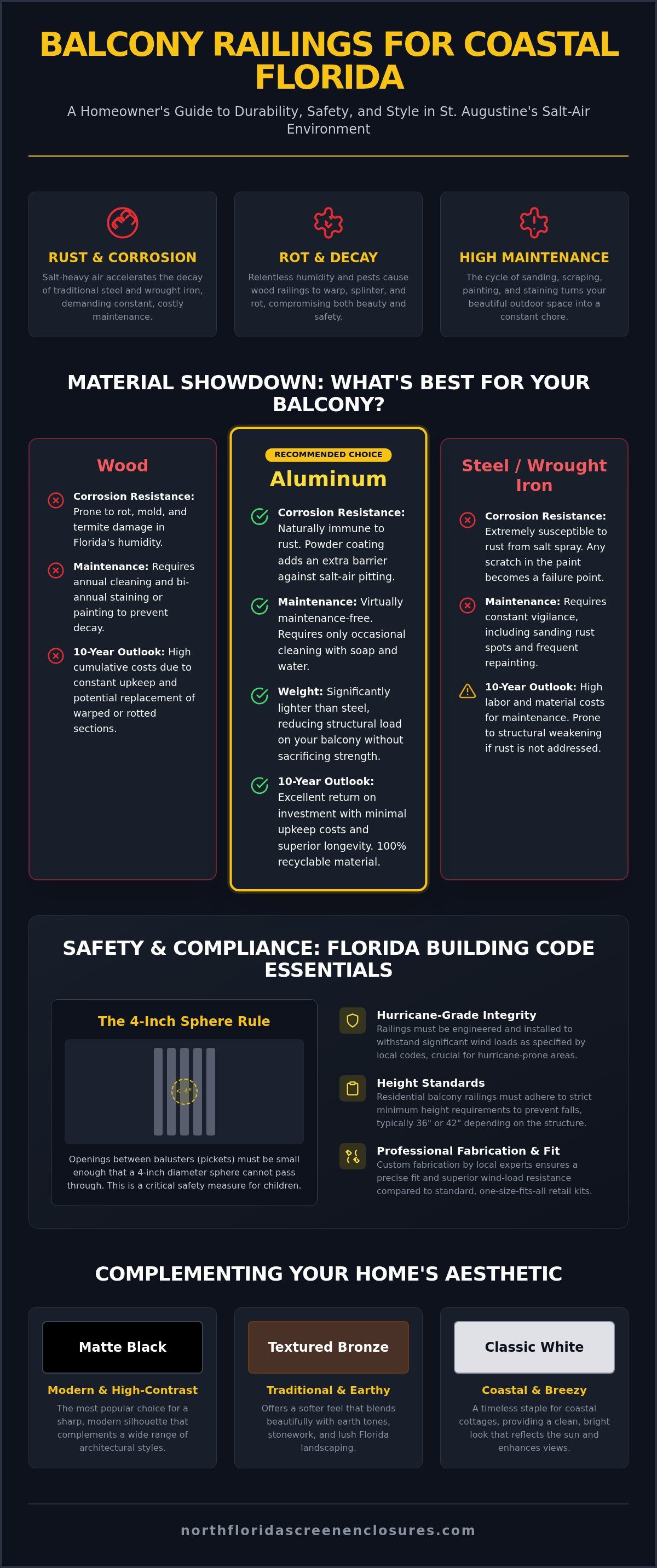
In the high humidity of St. Augustine, wood railings often succumb to rot and warping within just a few years. Wrought iron, while strong, requires constant painting to prevent the salt air from eating through the finish. Aluminum offers a distinct advantage because it's naturally resistant to oxidation. Unlike iron, it won't rust, and unlike wood, it won't decay or harbor pests. Additionally, aluminum is significantly lighter than steel, which reduces the dead load on elevated structures without sacrificing Handrail safety and support. This weight benefit makes it an ideal choice for multi-story homes where reducing structural stress is a priority.
The "Coastal Factor" in St. Augustine
Homes along the Atlantic coast face a unique challenge: salt spray. Microscopic salt particles settle on exterior surfaces, accelerating chemical reactions that destroy standard metal finishes. Aluminum protects itself through a natural oxide layer, but for coastal North Florida, we utilize advanced powder coating. This process fuses a protective polymer to the metal, creating a barrier that resists fading and pitting. Local homeowners are increasingly switching to aluminum balcony railings because they provide a reliable defense against the corrosive environment that typically destroys other materials within a decade.
The return on investment for aluminum is clear when viewed over a 10-year period. While wood might have a lower initial cost, the cumulative expenses add up quickly:
Annual pressure washing and intensive chemical cleaning.
Bi-annual staining or painting to prevent wood rot.
Periodic replacement of warped or splintering balusters.
Potential structural repairs due to termite damage or fungal decay.
Beyond the financial aspect, aluminum is a sustainable choice. It's 100% recyclable. Using it for your home's exterior reduces the demand for chemical treatments and paints that can leach into the local ecosystem. It's a practical, long-term solution that protects both your investment and the North Florida landscape. By choosing a material built for the coast, you ensure your home's exterior remains a source of pride rather than a source of labor.
Exploring Aluminum Railing Styles: From Pickets to Modern Cable
Modern aluminum fabrication has evolved significantly, allowing homeowners to choose designs that reflect their personal style while maintaining structural integrity. In a city as historic as St. Augustine, the exterior of your home needs to respect local architectural heritage. Whether you live in a Spanish Colonial revival or a modern beachfront property, your choice in aluminum balcony railings should complement the existing lines of your house. We focus on providing options that look like a natural extension of the building rather than an afterthought.
Color plays a major role in achieving this harmony. Matte black is currently the most popular choice for its high-contrast, modern silhouette. Textured bronze offers a softer, more traditional feel that blends well with earth tones and lush Florida landscaping. White remains a staple for classic coastal cottages, providing a clean and breezy look that reflects the sun. Many of our clients choose to coordinate their railing systems with their pool enclosure installation. Using consistent materials and finishes across all outdoor structures creates a unified appearance that significantly boosts curb appeal.
Classic Picket and Vertical Balusters
Traditional picket designs remain a favorite because they provide a timeless look that fits almost any neighborhood. When selecting a picket system, consider the top rail profile. A bread-loaf rail offers a rounded, ergonomic grip that feels comfortable underhand. Conversely, a flat-top rail provides a sleek, architectural edge that can even serve as a convenient place to rest a drink. We can customize picket spacing to ensure safety while maintaining as much visibility as possible, ensuring the design remains functional and attractive.
Modern Cable and Glass Infills
If your balcony overlooks the Matanzas River or the Atlantic, you likely want to maximize your view. Modern cable systems use thin, marine-grade stainless steel cables to provide safety without blocking the horizon. Glass infills are another premium option, acting as a windbreak while offering completely unobstructed sights. However, it's essential to ensure these systems meet the Florida Building Code for Balconies regarding load resistance and spacing. While glass requires more frequent cleaning to remove salt spray, the visual impact is often worth the extra effort for waterfront properties.
If you're unsure which style best suits your property, our team can help you evaluate the options based on your home's layout and exposure. You can view our previous custom aluminum projects to see how these styles look in local North Florida settings.
Compliance and Safety: Navigating Florida Building Codes for Balconies
Safety is the primary function of any elevated railing system. In North Florida, where high winds and salt air are constant factors, aluminum balcony railings must serve as more than just a decorative border. They are critical life-safety devices designed to prevent accidental falls and withstand the immense pressure of tropical storms. Understanding the legal requirements isn't just about passing an inspection; it's about ensuring the long-term protection of your family and guests.
Florida Building Code (FBC) Essentials
Residential property owners in St. Augustine must adhere to specific measurements to remain compliant. For most private homes, the code requires a minimum railing height of 36 inches. Commercial properties or multi-family dwellings often face a stricter standard of 42 inches. Another vital regulation is the 4-inch sphere rule. This mandate ensures that the spacing between balusters is tight enough to prevent a 4-inch sphere from passing through, which protects small children and pets from slipping through the gaps. Adhering to the Florida Building Code railing safety standards ensures that every installation provides a reliable safety barrier that meets state law.
Common code violations often occur during DIY projects where homeowners use non-compliant materials or incorrect spacing. Professional installation guarantees that your permit approval process goes smoothly. We ensure that every post and baluster is positioned with precision, removing the guesswork and potential liability that comes with unpermitted work. Compliance is the foundation of structural peace of mind.
Structural Integrity and Wind Loads
Structural design in Florida must account for significant wind loads. Railings are tested to resist a concentrated load of 200 pounds applied in any direction at the top rail. This ensures the system won't buckle if someone leans or falls against it. In coastal regions like ours, the wind resistance requirements can range from 110 to 180 mph depending on your specific zone. Aluminum is an ideal material for these demands because of its high strength-to-weight ratio and ability to maintain its shape under pressure.
The strength of the railing is only as good as its connection to the balcony. Over time, salt air can compromise the fasteners holding your posts in place, causing them to loosen or corrode. Meticulous attention to mounting hardware is essential. We prioritize using hurricane-rated fasteners and offer specialized tapcon replacement to restore the grip of your railings if the original hardware has degraded. This professional approach to structural engineering ensures your second-story balcony remains a secure environment even during the most demanding weather conditions.
Durability in the Salt Air: Maintenance and Longevity Secrets
While many manufacturers market aluminum as a "zero maintenance" solution, this is a dangerous oversimplification for Florida property owners. In our local climate, salt air is a persistent abrasive that can degrade even the toughest materials if ignored. High-quality aluminum balcony railings are indeed low-maintenance compared to wood or iron, but they still require a strategic care routine to reach their full potential. Neglecting basic upkeep allows salt crystals to bond with the surface, which can eventually lead to pitting or finish failure over several years.
The Powder Coating Advantage
The longevity of your railing system depends heavily on its finish. Most professional-grade aluminum uses powder coating, a process where dry powder is electrostatically applied and cured under heat to form a durable skin. For coastal environments like St. Augustine, we look for finishes that meet AAMA 2605 standards. This high-performance specification requires the coating to withstand 4,000 hours of salt spray testing, whereas the standard AAMA 2604 only requires 3,000. If you notice minor scratches from patio furniture or storm debris, it's vital to touch them up immediately with a matching paint pen. This prevents oxygen and salt from getting beneath the coating, which can cause the finish to bubble or peel over time.
Seasonal Maintenance Checklist
For homes within one mile of the Atlantic coast, salt accumulation happens daily. We recommend a simple fresh-water rinse every three months to prevent buildup. You don't need harsh chemicals; a garden hose and a soft cloth with mild soap are usually sufficient. During your inspection, pay close attention to the connection points and base plates where moisture tends to sit. If you see brownish streaks, it's often a sign of "bleeding" from non-stainless fasteners that need attention before hurricane season begins in June. Checking these points ensures the structural integrity remains intact when wind speeds increase.
Quarterly Rinsing: Use fresh water to clear salt and sand from balusters and rails.
Hardware Inspection: Verify that all mounting bolts are tight and free of rust.
Finish Check: Look for signs of "chalking" or fading that might indicate the need for a professional cleaning.
Base Plate Drainage: Ensure weep holes are clear so water doesn't pool inside the posts.
Maintaining the structural integrity of your exterior fixtures is a key part of protecting your property value. If you've noticed loose posts or faded finishes, it's time to consult with a specialist to ensure your home stays safe and stylish. You can contact North Florida Screen Enclosures to discuss upgrading your current system or scheduling a professional assessment of your home's aluminum structures.
Custom Aluminum Railing Solutions in St. Augustine
Choosing the right system for your home involves more than just picking a style. While big-box retailers offer standardized kits, these often fail to meet the specific structural and environmental demands of North Florida. Mass-produced railings frequently use thinner gauges of metal and lower-grade finishes that can't withstand our local climate. By choosing custom-fabricated aluminum balcony railings, you ensure that every component is designed specifically for your home's dimensions and exposure levels. North Florida Screen Enclosures takes pride in creating solutions that aren't just functional but are built to last as long as the house itself.
Our design philosophy centers on architectural harmony. We don't view a railing as a standalone feature; it's a critical component of your home's exterior envelope. This is why we focus on seamless integration with other structural elements, such as elite roofing systems and paver patios. When your balcony railing matches the finish of your screen enclosure or patio cover, it creates a polished, intentional look that significantly enhances property value.
Our Professional Installation Process
A successful installation begins with a comprehensive site evaluation. We perform precise measurements to account for any unique angles or structural irregularities common in St. Augustine's diverse housing stock. During the installation, we focus on precision anchoring, using high-performance hardware to secure the posts into the substrate. This ensures maximum structural safety and long-term stability. Our process concludes with a final walk-through and inspection to verify that every detail meets our rigorous internal standards and local building requirements.
Enhancing Your Entire Outdoor Living Space
Homeowners often find that a single-contractor approach is the most efficient way to manage exterior improvements. Beyond aluminum balcony railings, we can coordinate the installation of pergolas, soffit, and fascia to create a cohesive aesthetic across your property. This eliminates the frustration of dealing with multiple subcontractors who might use slightly different materials or color palettes. By trusting a specialized local team, you get a unified vision for your outdoor living space, backed by the accountability and expertise of craftsmen who live and work in your community.
Starting your project is a straightforward process. It begins with a consultation where we discuss your goals and assess your balcony's specific requirements. From the initial measurement to the final walk-through, our team remains focused on delivering a high-performance solution that provides both beauty and peace of mind.
Secure Your Coastal View with Professional Aluminum Solutions
Investing in your home's exterior requires a balance of aesthetic vision and technical precision. We've discussed how high-performance aluminum balcony railings provide the only reliable defense against the corrosive salt air that defines our North Florida landscape. By selecting materials designed for coastal durability and ensuring strict compliance with the Florida Building Code, you aren't just improving your home; you're securing it against the elements. Professional installation removes the guesswork, providing a structure that remains firm even during the high-pressure conditions of hurricane season.
Our team at North Florida Screen Enclosures takes pride in being a locally owned specialist that understands the unique structural demands of St. Augustine properties. From precision anchoring to the use of high-grade powder-coated finishes, we focus on the small details that ensure long-term structural integrity. You deserve the peace of mind that comes from knowing your balcony is as safe as it is beautiful. We’re committed to delivering diligent craftsmanship that protects your investment and enhances your outdoor living experience.
Request a Free Quote for Custom Aluminum Railings in St. Augustine to begin your transformation with a team committed to reliability and local expertise. We look forward to helping you build a secure outdoor space that stands the test of time.
Frequently Asked Questions
Are aluminum balcony railings strong enough for hurricanes?
Professional-grade aluminum railings are engineered to withstand wind loads between 110 and 180 mph. They meet the Florida Building Code's requirement to resist a 200-pound concentrated load applied in any direction. Because aluminum is non-porous and rigid, it doesn't catch the wind or weaken like organic materials. We use hurricane-rated fasteners to ensure the posts remain anchored even during significant storm surges and high-velocity wind events.
How much do aluminum balcony railings cost compared to wood?
While aluminum has a higher initial purchase price than pressure-treated wood, it offers a significantly lower total cost of ownership over a ten-year period. Wood requires annual staining, sealing, and eventual board replacement due to rot. Aluminum eliminates these recurring expenses and labor costs. Homeowners often find that the increased property value and lack of maintenance fees make aluminum the more economical long-term investment for coastal Florida properties.
Do aluminum railings rust in salt air environments like St. Augustine?
No, aluminum does not rust because it contains no iron. Instead, it develops a natural oxide layer that protects the metal from deep corrosion. In coastal areas like St. Augustine, we utilize high-grade powder coatings that meet AAMA 2605 standards to prevent surface pitting. This specialized finish ensures your aluminum balcony railings remain structurally sound and visually appealing even when exposed to constant salt spray and high humidity.
What is the standard height for a residential balcony railing in Florida?
The Florida Building Code requires a minimum height of 36 inches for residential guards on open-sided walking surfaces. This measurement is taken from the finished floor to the top of the rail. For commercial buildings or multi-family dwellings, the required height increases to 42 inches. Additionally, the spacing between balusters must be narrow enough that a 4-inch sphere cannot pass through, ensuring safety for children and pets on elevated balconies.
Can I install aluminum railings myself or should I hire a professional?
Professional installation is highly recommended to ensure full compliance with the Florida Building Code and local permitting requirements. Structural safety depends on precision anchoring and the use of specific hurricane-rated fasteners. A professional team understands the exact load-bearing standards required for second-story structures. DIY installations often fail inspections due to incorrect baluster spacing or inadequate mounting, which can lead to costly delays and potential safety liabilities for the homeowner.
How do I clean and maintain my aluminum railings?
Cleaning aluminum balcony railings is a simple process that requires only fresh water and mild soap. For homes near the coast, we recommend a thorough rinse every three months to remove salt accumulation and sand. Use a soft cloth or sponge to wipe down the rails, then rinse with a garden hose. Avoid using abrasive pads or harsh chemical cleaners, as these can damage the protective powder coating and diminish the finish's lifespan.
What colors are available for custom aluminum railings?
Custom aluminum systems are available in a wide variety of durable powder-coated finishes to match any architectural style. Matte black is currently a dominant trend for modern homes, while textured bronze and classic white remain popular for traditional St. Augustine designs. These finishes are electrostatically applied and baked on, providing superior resistance to UV fading and salt-air exposure compared to standard liquid paints used on other metal or wood railing systems.
How long do aluminum railings typically last in North Florida?
When properly installed and maintained, aluminum railings can last 20 to 30 years or more in the North Florida climate. Their lifespan far exceeds that of wood, which often rots within seven years, or wrought iron, which can show significant rust in coastal air within a decade. The combination of a naturally corrosion-resistant core and a high-performance powder-coated finish makes aluminum the most durable choice for long-term exterior use.


Comments